All American Sports Cafe
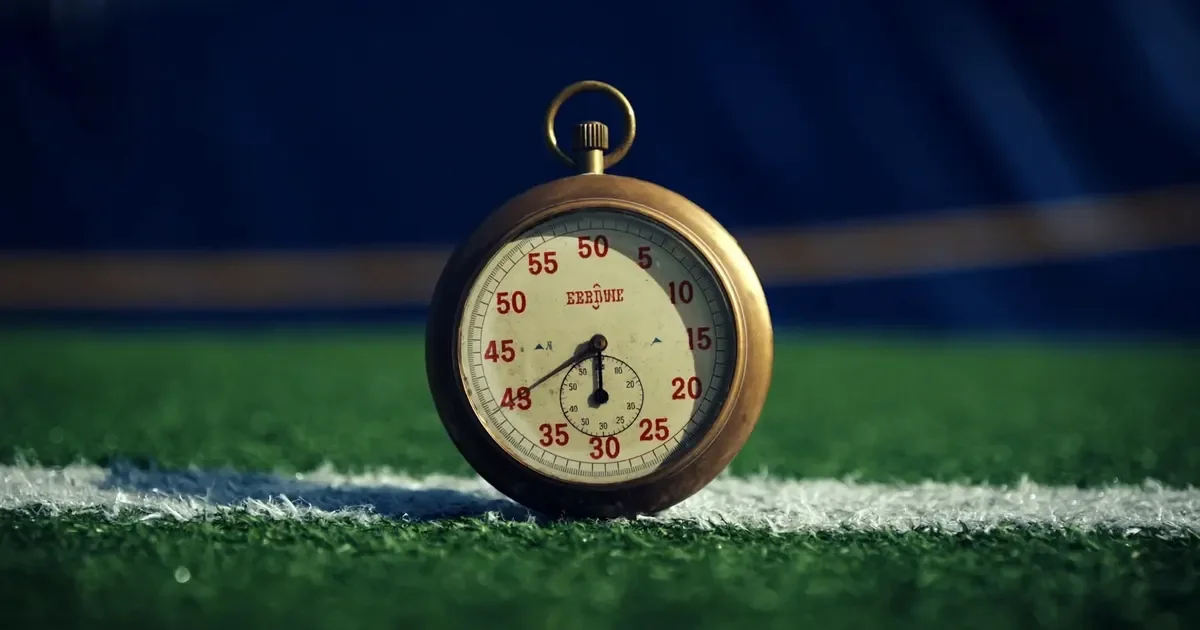
A football game lasts 60 minutes of game clock, split into four 15-minute quarters, in both the NFL and college football. In real time an NFL game usually takes a little over three hours, and college games run longer: CBS Sports put the 2024 average for major college football at 3 hours 27 minutes.
The gap between 60 minutes and three-plus hours comes from how often the clock stops, the time allowed between plays, halftime and television breaks. This page explains the quarters and breaks, the clock rules that stretch a game, how college differs from the NFL, and what overtime adds. If you are still learning the basics, American football for beginners explains downs and scoring.
Quarters, breaks and halftime
Rule 4 of the 2026 NFL rulebook states it plainly: the game is 60 minutes, divided into four periods of 15 minutes each. College football uses the same 60 minutes and the same four 15-minute quarters. The differences are in the breaks.
- NFL break between the first and second quarters, and between the third and fourth: at least two minutes, and the teams switch ends.
- College break between those quarters: one minute, which can be extended for radio and television timeouts.
- NFL halftime: 13 minutes.
- College halftime: 20 minutes in the regular season, unless both schools agree before the game to shorten it.
The Super Bowl is the big exception to the NFL figure. Its halftime show stretches the break well beyond 13 minutes, which is a large part of why Super Bowls take longer than regular-season games.
Why 60 minutes takes three hours
The game clock does not measure action. It keeps running between many plays while teams huddle and line up, and it stops completely for many others. A widely cited 2010 Wall Street Journal study of NFL broadcasts found the ball was actually in play for only about 11 minutes per game. Most of the 60 minutes on the clock tick away between snaps.
On top of that comes all the time when the clock is stopped. A simple bit of arithmetic shows how much. A three-hour broadcast window is 180 minutes. Take away the 60 minutes the game clock runs and 120 minutes are left in which the clock is stopped. Halftime (13 minutes) and the two-minute breaks after the first and third quarters (4 minutes) account for only 17 of them. The other 103 minutes or so come from stoppages of every kind.
The play clock sets the pace between snaps. After most plays the offense has 40 seconds to snap the ball, and 25 seconds after certain administrative stoppages, and teams often use most of it. Each NFL team also gets three timeouts per half; a charged timeout lasts two minutes when television uses it for a commercial and 30 seconds otherwise. Add commercial breaks after scores and changes of possession, replay reviews, injuries, measurements and penalty enforcement, and the stopped time piles up quickly.
When the NFL clock stops and restarts
The NFL's clock rules explain why the last few minutes of a close game can take half an hour of real time. The game clock stops:
- When a forward pass is incomplete
- When the ball or ball carrier goes out of bounds
- After a score, a change of possession, or a down with a foul
- At the two-minute warning, an automatic timeout near the end of each half
- For team timeouts, injuries and officials' timeouts
Restarting is where the detail lies. After a runner goes out of bounds, the clock normally starts again when the referee signals that the ball is ready for play, not on the snap. That changes after the two-minute warning of the first half and inside the last five minutes of the second half, when the clock waits for the next snap. After an incomplete pass, the clock always waits for the snap.
So early in a game, a run out of bounds costs only a few seconds of clock. Late in the fourth quarter, the same play stops the clock until the next snap, and a trailing team can string together sideline throws, spikes and timeouts. A team with timeouts left can fit many plays into those two minutes, each followed by a stoppage, which is why the final two minutes so often take far longer than two minutes.
College football: same clock, longer games
College games share the 60-minute, four-quarter structure but usually take longer. Several things add time:
- A longer halftime: 20 minutes instead of 13.
- A lot of plays. CBS Sports counted about 175 combined plays per game in the 2024 season, including special teams and live-ball penalties.
- Out-of-bounds stoppages that restart on the referee's signal before the two-minute timeout, and on the snap after it.
- Television breaks, which stretch the one-minute quarter breaks and other pauses.
College football has tried to trim game length. Since 2023, in Divisions I and II, the clock no longer stops after a first down except in the last two minutes of each half. In 2024 the rules added a two-minute timeout in the second and fourth quarters, similar to the NFL's two-minute warning, which also lines up the late-half timing rules.
Even so, games have not become shorter. The 2024 average of 3 hours 27 minutes was tied for the second-longest since the NCAA began tracking game length in 2008, and the 11 College Football Playoff games that season averaged about 3 hours 29 minutes, according to CBS Sports.
Overtime adds more time
A tie after four quarters means more football. In the NFL regular season, overtime is a single 10-minute period after a break of up to three minutes, and the game can still end in a tie. In the playoffs, overtime continues in 15-minute periods, with two-minute breaks between them, until there is a winner. Each team gets a guaranteed chance at the ball in both formats. Our explainer on NFL overtime rules covers the possession rules and how they changed in 2022 and 2025.
College overtime has no clock at all. Teams alternate possessions from the opponent's 25-yard line, and from the third overtime each possession is a single two-point play from the 3-yard line. How long a college overtime lasts depends on how many rounds it takes, not on a clock.
The Super Bowl and other special cases
The Super Bowl is the longest NFL game of the year in real time. Sports Illustrated's review of past Super Bowls put the average at about 3 hours 38 minutes, with the extended halftime show doing much of the stretching. The longest, Super Bowl XLVII, ran about 4 hours 14 minutes, helped by a power outage in the stadium.
Other things can lengthen any game: weather delays such as a stoppage for lightning in the area, injuries that need long evaluations, and long replay reviews late in close games. High-scoring games run longer too, because every touchdown brings a try, a kickoff and often a commercial break.
Low-scoring games with lots of running plays tend to move faster, because a tackle in bounds keeps the clock running.
Game length quick reference
- Game clock: 60 minutes in four 15-minute quarters, in the NFL and in college.
- Breaks after the first and third quarters: at least 2 minutes in the NFL, 1 minute in college (longer with TV timeouts).
- Halftime: 13 minutes in the NFL, 20 minutes in college, longer at the Super Bowl.
- Typical NFL game in real time: a little over 3 hours.
- Typical major college game: about 3 and a half hours (3:27 average in 2024).
- Super Bowl: about 3 hours 38 minutes on average.
- Ball actually in play: roughly 11 minutes (2010 Wall Street Journal study).
- NFL regular-season overtime: up to 10 minutes; playoff overtime has no limit.
Frequently asked questions
How many quarters are in a football game?
Four. In both the NFL and college football, a game has four quarters of 15 minutes each, for 60 minutes of game clock. Overtime is added only if the score is tied at the end of the fourth quarter.
How long is halftime in football?
Halftime is 13 minutes in the NFL and 20 minutes in a regular-season college game, unless both schools agree to shorten it. The Super Bowl halftime is longer because of the halftime show.
How long does an NFL game last in real time?
Usually a little over three hours from kickoff to the final whistle. Overtime, long replay reviews, injuries or weather delays can push it longer, and the Super Bowl averages closer to three hours and 40 minutes.
Why are college football games longer than NFL games?
College halftime is 20 minutes instead of 13, games include a lot of plays, and television breaks add time. Even after the 2023 change that keeps the clock running after first downs for most of each half, the 2024 average was 3 hours 27 minutes.
How much actual action is there in a football game?
Very little compared with the length of the broadcast. A 2010 Wall Street Journal study of NFL broadcasts found the ball was in play for about 11 minutes per game. The rest is time between plays, stoppages, halftime and commercials.
How long is each quarter in real time?
There is no fixed figure. If an NFL game takes three hours, taking out the 13-minute halftime leaves 167 minutes, or about 42 minutes per quarter on average. Fourth quarters of close games often take longer, because more clock stoppages, timeouts and reviews pile up near the end.