All American Sports Cafe
There are four downs in American football. The offense gets four plays, called downs, to move the ball at least 10 yards; if it gets there it earns a new first down and four more tries, and if it does not, the ball usually goes to the other team. That is the rule in the NFL and in college football, while Canadian football gives the offense only three downs to gain the same 10 yards.
If you are new to the sport, start with American football for beginners for the field, scoring and positions. This page goes deeper into the downs system, using the 2026 NFL rulebook, the 2026 NCAA football rules book and the CFL's 2026 rule book.
Four downs to gain 10 yards: what the rulebook says
The NFL rulebook defines a series of downs as the four consecutive charged scrimmage downs the offense gets to advance the ball to a yard line called the line to gain, in order to keep possession (Rule 3, Section 8). A few words in that definition do more work than they seem to.
- Scrimmage downs. A down that counts toward the four starts with a snap. A kickoff is a free kick down and is not part of the series.
- Charged downs. A down only counts if it is charged. When a penalty wipes out a play, the down is usually played over, which is why you hear the referee announce "repeat third down".
- The line to gain. This is the spot 10 yards ahead of the snap that started the series. If the goal line is less than 10 yards away, the goal line becomes the line to gain.
A new series, and with it a new first down, is awarded when the ball is declared dead in the offense's possession at or beyond the line to gain, or when a defensive penalty either moves the ball to that line or carries an automatic first down (Rule 7, Section 3). A 40-yard catch earns exactly one first down, and the next 10 yards are measured from wherever that play ended. When the ball changes hands, the team that gains it starts its own series at first and 10.
Down and distance: reading first and 10 or third and 3
The scoreboard and the broadcast describe every snap with two numbers: the down and the yards still needed. "Second and 6" means second down with 6 yards to go to the line to gain. Progress is measured from the forward point of the ball where the play was ruled dead, and the ball is turned so its long axis runs parallel to the sidelines before anyone measures (Rule 7, Section 3).
Here is a hypothetical series with the arithmetic shown. The offense starts with first and 10 at its own 30-yard line, so the line to gain is its own 40.
- First down: a 4-yard run to the 34. Now it is second and 6 (10 - 4 = 6).
- Second down: an incomplete pass. The ball stays at the 34, so it is third and 6.
- Third down: the quarterback is sacked for a 3-yard loss at the 31. Now it is fourth and 9 (6 + 3 = 9).
- Fourth down: the coach has to choose between a punt, a field goal try and going for it.
Penalties on the offense change the distance too. If an offensive foul is enforced and leaves the ball short of the line to gain, the down number stays the same (Rule 14, Section 1). Take offensive holding on first and 10 at the 30, enforced from the previous spot: the ball goes back 10 yards to the 20, the line to gain is still the 40, and the next snap is first and 20.
First and goal
When a series begins less than 10 yards from the opponent's end zone, the goal line is the line to gain. Snap the ball on first down from the opponent's 6 and the graphic reads "first and goal at the 6". Short gains cannot earn a new set of downs here; the offense has four downs to score, and only a touchdown or a defensive penalty that awards a first down resets the count.
The line to gain, the chains and how measurements work
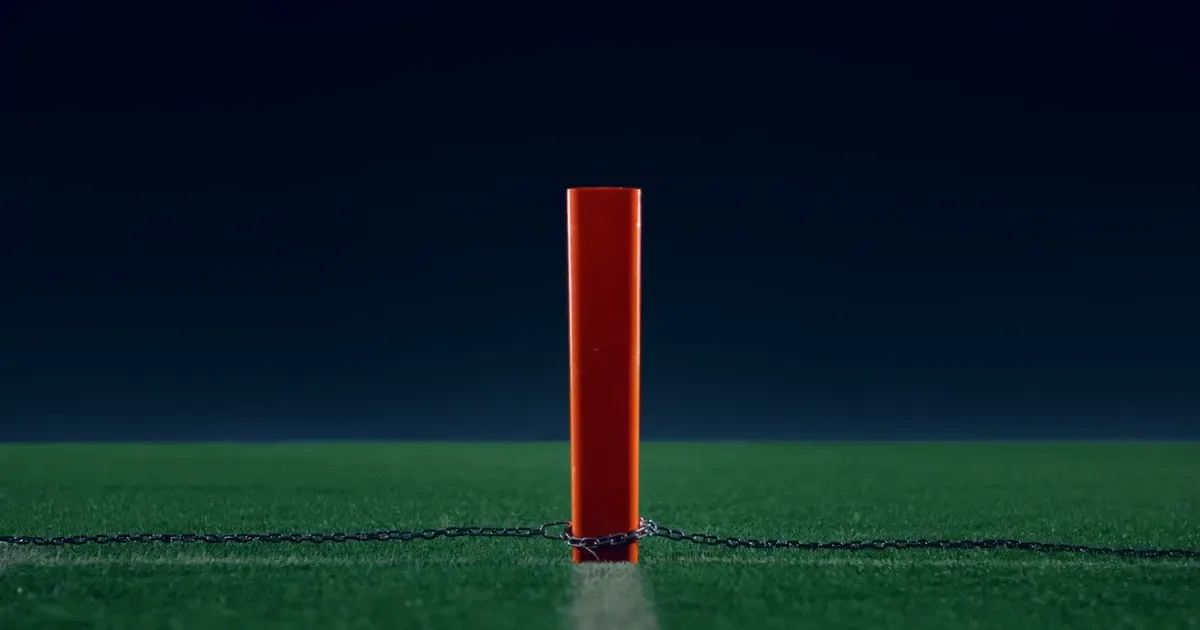
The traditional way to track the line to gain is the chain, worked by the chain crew (often called the chain gang) along the sideline. The college rules spell out the equipment. The yardage chain joins two rods at least 5 feet high whose inside edges are exactly 10 yards apart when the chain is fully extended, and a separate down indicator on its own rod shows the number of the down. Both are operated about six feet outside the sideline, on the side of the field opposite the press box (2026 NCAA Rule 1-2-7). One rod marks where the series started and the other marks the line to gain. The NFL rulebook requires its chain crew to wear white shirts (Rule 1, Section 4).
When a play ends close to the line to gain and the spot is too tight to judge by eye, the officials measure. The NFL rulebook lets the referee stop the clock for a possible first-down measurement without charging a timeout to either team, and the clock then restarts as if that stoppage had not happened (Rule 4). In college, the rule says a questionable distance should be measured without anyone asking, unnecessary measurements should not be granted, and no request is granted once the ball is ready for play (2026 NCAA Rule 5-1-3).
The NFL has handed most of that job to cameras. Starting with the 2025 season, the league made Sony's Hawk-Eye system the primary method for measuring the line to gain, using six 8K cameras to track the ball, with the chain crew staying on the field in a secondary role. The official still spots the ball, and the system measures from that spot. In a September 2026 release looking back at the 2025 season, the NFL said Hawk-Eye handled 21 virtual measurements and completed each in nearly half the average time of the chains.
The spot itself can be reviewed. Under the NFL's replay rule, the dead-ball spot is reviewable to decide whether it was short of, at or beyond the line to gain, and the replay official can start a review of a ruling that the offense failed to reach the line to gain on fourth down (Rule 15).
Penalties that give an automatic first down
In the NFL, most fouls by the defense hand the offense a new set of downs. The 2026 rulebook says that after a penalty for a defensive foul the next down is first and 10 for the offense, and then lists the exceptions (Rule 14, Section 1). The exceptions are offside, encroachment, neutral zone infraction, delay of game, illegal substitution, excess timeouts, running into the kicker, having more than 11 players on the field or in the formation, and an illegal defensive formation on a scrimmage kick. For those, the down stays the same unless the penalty yardage itself carries the ball to or past the line to gain.
These are the fouls you will hear tied to a first down most often, with the penalty wording from the 2026 NFL rulebook:
- Defensive holding: loss of 5 yards and an automatic first down.
- Illegal contact: loss of 5 yards and an automatic first down.
- Illegal use of hands by the defense: loss of 5 yards and an automatic first down.
- Defensive pass interference: first down for the offense at the spot of the foul, which can be worth 40 yards or more on a deep throw.
- Roughing the passer: loss of 15 yards and an automatic first down.
- Roughing the kicker or the holder: loss of 15 yards and an automatic first down. Running into the kicker, the milder foul, is 5 yards with no automatic first down.
- Unnecessary roughness, facemask, horse-collar tackle and hip-drop tackle: loss of 15 yards and, when the defense commits them, an automatic first down.
The difference shows up most on third down. Picture third and 8 at the offense's own 30, so the line to gain is the 38. A pass falls incomplete, but a defender was flagged for holding. The 5 yards move the ball to the 35, and instead of third and 3 the offense has first and 10 at the 35, with a new line to gain at the 45. Swap the foul for defensive offside and the ball still moves 5 yards to the 35, but there is no automatic first down, so it is third and 3. Now make it third and 4 at the 30 with the line to gain at the 34: the same offside penalty moves the ball to the 35, past the line, and the offense gets a first down from the yardage alone.
College football uses different numbers. Under the 2026 NCAA rules, defensive holding is 10 yards plus an automatic first down, and roughing the passer is 15 yards plus an automatic first down. Defensive pass interference is a spot foul and a first down only if it happened fewer than 15 yards beyond the previous spot; farther downfield it is 15 yards from the previous spot plus a first down.
Fourth down: punt, kick a field goal or go for it
Fourth down is the last try in the series, and coaches have three choices.
Punt. The punter kicks the ball away on purpose so the opponent starts much farther from the end zone it is attacking.
Field goal. If the ball is close enough, the kicker tries for 3 points. The broadcast rule of thumb adds 17 yards to the yard line (10 for the end zone and about 7 for the snap back to the holder), so fourth down at the opponent's 25 means a 42-yard attempt (25 + 17 = 42).
Go for it. The offense runs a normal play and needs to reach the line to gain. Make it and the drive continues with a fresh first down. Miss and the other team takes over where the play ended.
The choice comes down to the distance needed, field position, the score, the time left and how much the coach trusts the kicker. Two hypothetical cases show the logic. On fourth and 9 at your own 31, a failed attempt would hand the opponent the ball 31 yards from a touchdown, so a punt is the normal call unless you are trailing late and need the ball back. On fourth and 1 at the opponent's 40, a punt gains little field position, a field goal would be a 57-yard try (40 + 17 = 57), and the offense only needs one yard, so the case for going for it is strong.
Late in a game the clock takes over. A team down by 10 with three minutes left may go for it on fourth and 6 near midfield, because a punt might mean never getting the ball back.
One NFL quirk applies only on fourth down. If the offense fumbles during a fourth-down play, the player who fumbled is the only offensive player allowed to recover and advance the ball. If a teammate recovers it instead, the ball is dead and spotted where it was fumbled, or where it was recovered if that spot is farther back.
Turnover on downs and field position
If the offense uses all four downs without reaching the line to gain, the ball goes to the defense at the spot where the last play ended. The NFL rulebook treats this as a change of possession, and commentators call it a turnover on downs. The team taking over starts its own series with first and 10.
A hypothetical example: fourth and 2 at the opponent's 35. The run gains 1 yard to the 34 and is stopped. The defense takes over with first and 10 at its own 34, so its own line to gain is the 44, and it needs 66 yards for a touchdown (100 - 34 = 66).
That is why teams rarely go for it deep in their own territory: a failed fourth down at your own 10 gives the opponent the ball 10 yards from a touchdown. If your ball carrier is tackled in your own end zone on any down, it is a safety, worth 2 points to the defense; our guide to what a safety is in football explains that play in full.
College football and the CFL: what changes
College football uses the same core rule. Under the 2026 NCAA rules a series is up to four consecutive scrimmage downs, and the line to gain is set 10 yards ahead of the most forward point of the ball, with the goal line taking its place when that spot would be in the end zone (Rule 5-1). The big difference for viewers is the clock. In college, the game clock stops when the offense earns a first down, by a play or by a penalty, but only after the two-minute timeout in the second and fourth quarters, and it restarts on the referee's signal (Rule 3-3-2). Earning a first down does not stop the NFL game clock. Our breakdown of how long a football game lasts covers the rest of the clock rules.
Canadian football is where the number itself changes. The CFL's 2026 rule book gives the offense three downs to gain 10 yards; if it fails, the ball goes to the other team as first down where the ball became dead. Teams play 12 a side, and in 2026 the field is 110 yards long and 65 yards wide. With one fewer down, third down in Canada is the usual down for punting or kicking a field goal, the role fourth down plays in the NFL.
The CFL has announced field changes for 2027: the field will shrink from 110 to 100 yards and the end zones from 20 to 15 yards deep, with the goalposts moved to the back of the end zones. The league's own FAQ says three downs and 12 players on the field remain part of the game.
Quick reference: downs at a glance
Keep this list handy for your next game:
- NFL and college: 4 downs to gain 10 yards. CFL: 3 downs.
- Line to gain: 10 yards from the snap that started the series, or the goal line if that is closer (first and goal).
- Gain the yards and the count resets to first and 10. Fail on fourth down and it is a turnover on downs at the spot.
- Most NFL defensive fouls give a first down; offside, encroachment and delay of game are the common exceptions.
- Defensive holding: 5 yards plus a first down in the NFL, 10 yards plus a first down in college.
- NFL measurements: Hawk-Eye cameras first since 2025, chains as backup.
- Fourth-down choices: punt, field goal (yard line + 17 for the kick distance) or go for it.
Downs in football: common questions
How many downs do you get in football?
Four in the NFL and in college football. The offense has four downs to gain 10 yards, and each time it does, it gets a fresh set of four. Canadian football in the CFL gives the offense three downs to gain 10 yards.
What is a first down?
A first down is the first play of a new series. The offense earns one by moving the ball to or past the line to gain, 10 yards from where the series started, or through a defensive penalty that awards an automatic first down.
What happens if a team does not get a first down on fourth down?
The other team takes over at the spot where the fourth-down play ended. This is called a turnover on downs, and the new offense starts with first and 10 from that spot.
Does defensive holding give an automatic first down?
Yes. In the NFL, defensive holding is a 5-yard penalty plus an automatic first down. In college football under the 2026 NCAA rules it is 10 yards plus an automatic first down.
Does a down count if there is a penalty?
Usually not. When a penalty is accepted, the down is normally replayed, which is why the referee says "repeat second down" or similar. A defensive foul often gives a new first down instead, and a few offensive fouls, such as intentional grounding, also cost the offense a down.
Is the yellow first-down line on TV official?
No. It is a graphic added by the broadcaster to show roughly where the line to gain is. The officials' spot, and in the NFL a Hawk-Eye or chain measurement when needed, decides whether the offense made the first down.